4,000 officers prepare for day of protest in central London this weekend
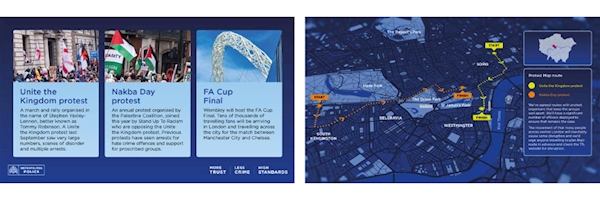
This weekend is set to be one of the busiest of the year for policing in London and requires significant resource to keep people safe, with two major protests in central London and the FA Cup Final at Wembley drawing large crowds across the city.
The first protest, marking Nakba Day, will move from Exhibition Road to Pall Mall, organised by the Palestine Solidarity Campaign, Stop the War, Stand Up to Racism and other groups. The second, under the ‘Unite the Kingdom’ banner, is organised in the name of Stephen Yaxley Lennon (Tommy Robinson) and will proceed from Kingsway to Parliament Square.
The FA Cup Final at Wembley will also take place, with high numbers of fans travelling throughout London.
This operation takes place against a heightened security and terror threat backdrop. The terrorism threat level is at severe, there has been a recent terrorist attack, and there has been a series of arson attacks targeting Jewish Londoners. At the same time, levels of hate crime are increasing, particularly antisemitism. This is contributing to increased concern across communities. Jewish communities are feeling particularly vulnerable, but we are also seeing heightened concern in Muslim communities and across other groups.
Taken together, these factors increase the risk of disorder, hate crime and tension between groups. Our policing plan is designed to give us strong oversight of crowd movement and the ability to respond quickly and effectively to any emerging issues.
Approximately 4,000 officers will be part of the public order policing operation across London. This will include 660 officers from other police forces across England and Wales.
In addition to the officers, you see out on foot, there will be specialist traffic units, officers on horses, police dogs, police helicopters, drone teams and detectives, whose job it is to investigate offences that take place at protests. Officers will have full access to their protective equipment, should they need it, and we will have specialist armoured vehicles available for use as a very high-level contingency option.
We are also taking an assertive and proactive approach to using the powers available to us in law such as Public Order Act conditions governing start and finish times, routes etc, dispersal orders and increased search powers for officers.
This Saturday is also the first time we will be using live facial recognition (LFR) as part of a protest policing operation. It will be deployed in Camden in an area likely to be used by those attending the Unite the Kingdom event.
The event is expected to attract significant numbers, and we have intelligence which indicates that there is likely to be a threat to public safety from some who might be in attendance. LFR won’t be deployed within the assembly or rally points of either protest or on the route itself.
The cameras are comparing the faces of those walking past with the faces of those on a specific watch list. If a potential match isn’t detected the biometrics are deleted in just seconds and cannot be recovered.
You can read further detail about the planned policing operation for Saturday here.